Araara cb — referencing

This is the seventh in a series of expository blog posts on Araara. The preceding post introduced Akurtosks, a shorter way to represent strings. The series begins here.
We can now write integers, Unicode code points, strings, and alphabets. But perhaps we would like to refer to a book? Or an element? Or another galaxy?
Many things already have numbers assigned to them. We need a convention that tells us what those numbers refer to.
A number in context
In Unicode normal form, we prepend ui to the normal form of a code point. The prefix contributes zero, preserving the number while giving it a particular interpretation.
We can adopt similar conventions elsewhere. A short prefix identifies the system we are using; what follows identifies something within that system.
These interpretations are conventions. The product of the u and non-u alphabets does not, by itself, have to be about Unicode. That was one use of the construction!
Counts and colour components will use ordinary Akurto normal form. Catalogue identifiers will be encoded as Unicode strings.
A book
Let’s start with something we can hold in our hands.
Eric Carle’s The Very Hungry Caterpillar is a wonderful children’s book. One edition has ISBN 9780399208539. An ISBN identifies a particular edition and format, so another edition of the same story can have a different ISBN. Publisher listing
We will use iuszbpnm for ISBN references. Each adjacent pair contributes zero:
iu sz bp nm = 0
An ISBN is a long sequence of decimal digits. Here, we will encode those digits as a string using an Asks, rather than expressing the entire ISBN as one large integer.
Our book reference becomes:
iuszbpnm uifdb uifd uifda uifcb uifcc uifdb uifdb uifcbb uifcb uifda uifccb uifcc uifdb
The spaces are just for readability. After the initial iuszbpnm, each Unicode normal form encodes one digit of the ISBN.
This expression refers to an edition in which we can read the story.

An element—and an atom
Chemical elements have an especially satisfying identifying number: the number of protons in an atom.
We will use PB, with P reminding us of protons:
PB
Oxygen has atomic number eight. Since eight has normal form cba, we can refer to oxygen by:
PBcba — oxygen: 8 protons
Having eight protons is what makes an atom an oxygen atom. Here, the identifying number has a physical meaning.
We can give more information by adding neutron and electron counts. Let NM introduce neutrons and EA introduce electrons.
For example:
PBca NMca EAca — 6 protons, 6 neutrons, 6 electrons
This specifies a neutral carbon-12 atom. Changing the neutron count changes the isotope; changing the electron count changes the charge. The proton count still determines the element.
Another galaxy
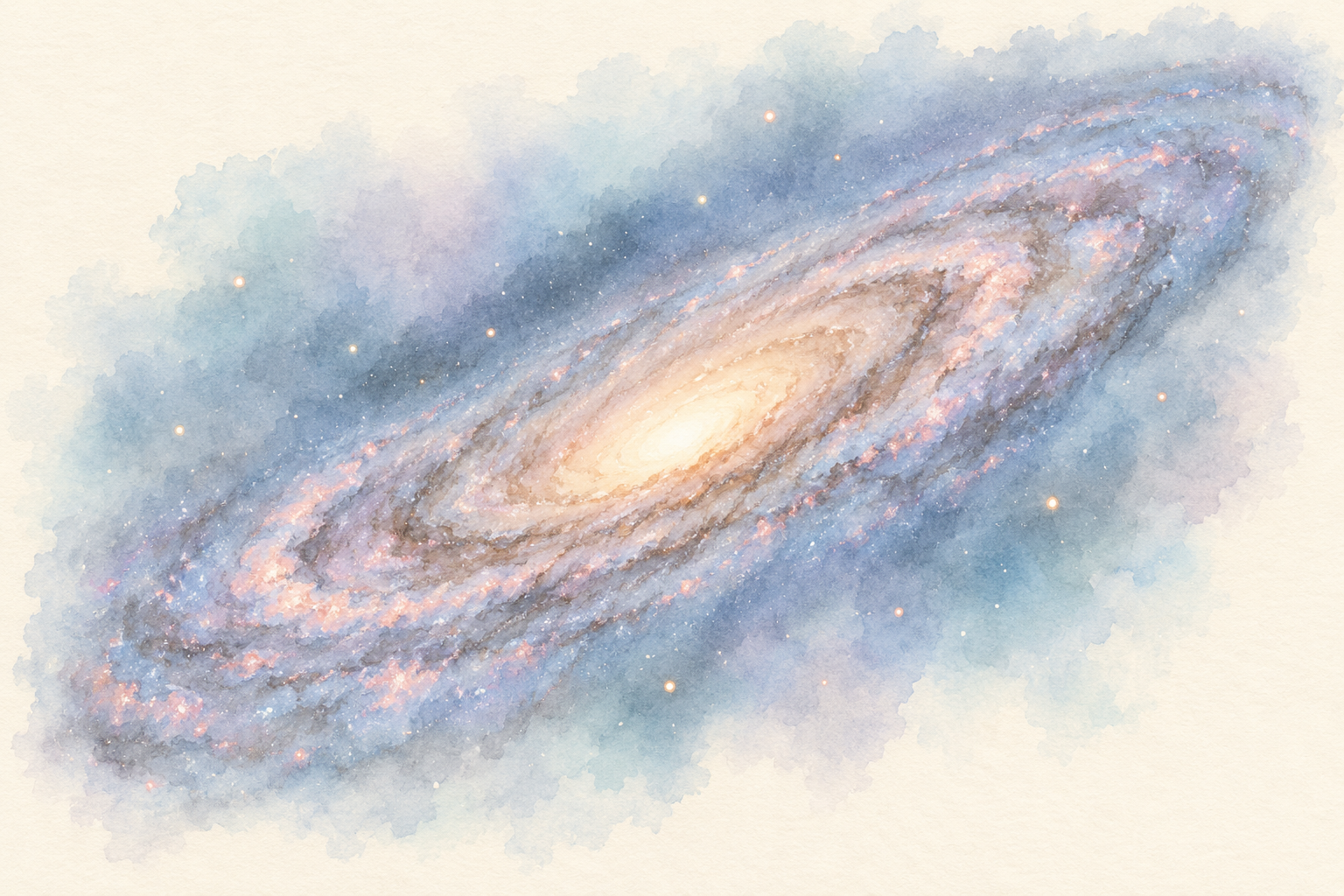
The Messier catalogue gives astronomical objects familiar numerical identifiers. The Andromeda Galaxy is M31, or Messier 31. NASA
Let’s adopt mn as our Messier prefix. We follow it with ‘M31’ encoded in short Unicode form: ‘M’ has code point 77, ‘3’ has 51, and ‘1’ has 49.
mn uiffj uifcc uifcba — ‘M31’, in short Unicode form
A few letters now refer to another galaxy. Isn’t that cool?
As with ISBNs, we are relying on an existing reference system. The identifier “M31” names Andromeda within the Messier catalogue; our prefix declares that context.
A colour
We can also specify something by combining several numbers.
In the familiar eight-bit RGB representation, a colour has red, green, and blue components, each from zero to 255. We will use the sRGB colour space. W3C
Let the components begin with:
rl — red
gk — green
bp — blue
We follow each prefix with its component value in normal form, keeping the order red, green, blue. These values specify numerical channel levels: zero is the minimum and 255 the maximum. They are quantities, so we keep them as numbers.
For a warm peach, choose RGB (255, 220, 180):
rlggcca gkgffdb bpgfdba — RGB (255, 220, 180)
The three numerical fields remain distinguishable. Summing the whole expression would give 655, but that sum would no longer tell us the colour.
Here, we are specifying the colour through its components.

Wikidata
Wikidata provides numbered records for a wide range of things. Its item Q2, for example, refers to Earth. Wikidata
We will use wy for Wikidata references, followed by the identifier’s letter in short Unicode form, then o, then its decimal digits, also in short Unicode form.
The letter ‘Q’ has code point 81. Its short Unicode form is:
uigv = −1094 + 1094 + 122 − 41 = 81
The digit ‘2’ has code point 50. Earth’s identifier therefore becomes:
wyuigvouifdj — Wikidata Q2: Earth
Read this as:
wy — Wikidata
uigv — ‘Q’, in short Unicode form
o — separates the letter from the digit string
uifdj — ‘2’, in short Unicode form
We have preserved both parts of the identifier, without needing to introduce uppercase letters into the Aglobasa alphabet itself.
Exercises
- Write references to hydrogen and carbon using PB. Then specify a neutral carbon-13 atom.
- Messier 1 is the Crab Nebula. Write its Messier reference.
- Express pure red, pure green, and pure blue using our RGB convention. What happens if you sum each expression?
We have used the same letters to refer to a book, an element, a galaxy, a colour, and Earth. The arithmetic remains available, but the declared conventions give the expressions further meaning.
In the next post, we will introduce yet another alphabet. An ancient one.