Araara o — Introduction

This is an introduction to a series of expository blog posts on Araara.
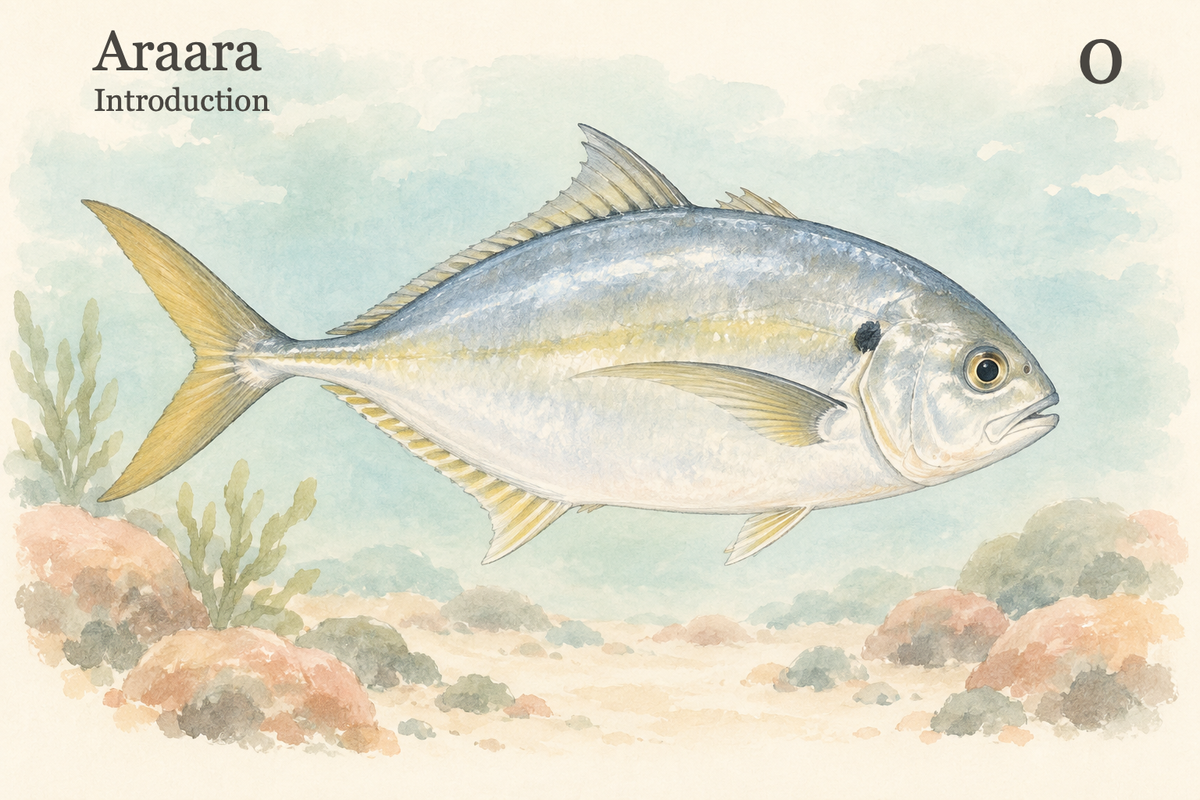
Araara is a personal mathematical research programme. Most of the conceptual work was done during a month-long backpacking trip to Aotearoa. It is named after the Māori name for the trevally (Pseudocaranx georgianus).
Its aim is not to produce new mathematical or non-mathematical knowledge. Rather, its aim is to index existing knowledge so it becomes more intuitive and consilient. (Incidentally, Araara is therefore also almost wholly unaffected by the October 2026 shockwaves rippling through the mathematical community following an influx of claimed proofs and disproofs of high-profile conjectures.) In order to pursue its aims, Araara will slowly build up towards what it will call autothets, or auto-epithets: computable epithets, usually of concrete objects, containing some measurement of that object. For example, we will be able to compute an autothet for the Sun that contains information about its mass, another about its distance to Earth, and yet another about its apparent brightness to us. By comparing autothets between different concrete objects, we get a more intuitive sense of relative scale.
So why not just look up these properties for the Sun, and call it a day? Well, surely we can do that, and if we would just be interested in this one question, it would be a significantly less time-consuming approach. It would also miss the point. By finding a way to systematically compute autothets for most everything under the Sun, we obtain a coherent universe of names that capture the physical, measurable, and, hopefully, relational dimensions of our world without requiring us to understand advanced physics at all: all we have to do is to know or look up the computed names of concrete objects to then intuitively grasp how they stand in proportion to the names of other concrete objects. Autothets extend (not replace) the various beautiful "etymological webs" with a naming scheme that is entirely logical, internally coherent, and deterministic, yet still intuitive and easy to use.
To have such a logical scheme does not mean it has to be cold, dry, and inaccessible to non-experts, like how many otherwise fascinating scientific facts are typically presented within the academic literature, hidden away in specialized journals. Instead, Araara's approach is to have a virtually unlimited number of ways to express each autothet. This allows for maximum poetic expressivity, stretching words in various creative and poetic ways while keeping their meaning identical. Another goal of Araara is to develop a new notation for quantum calculus (QC), and, using that notation, to present a range of (undergraduate) mathematical results in a possibly more concise and memorable way compared to how they are usually stated in calculus textbooks. Together with the aforementioned autothetical universe, my dream is that achieving these simple—yet fully faithful—representations will allow knowledge to better percolate from expert circles to various people like myself who are "often curious", but who may not always have the required foundational understanding to grasp scientific and mathematical truth. (It is explicitly not an aim to simplify any mathematics that extends beyond an undergraduate level; we will happily leave that to the experts and to those burdened with writing mathematics textbooks.)
It should be clear that Araara is, overall, quite an ambitious project. I would like to therefore emphasize a few more things. First, please be aware that this is just an experiment. I do not claim that any of the aforementioned ambitious goals are met: the sole promise is to make a genuine attempt. Time will tell if it will succeed, partly succeed, or, most likely, end as a failed attempt, doomed to obscurity, as so many of the false trails littering intellectual history, by both well-known thinkers and lesser known thinkers. In pursuing this programme and documenting it here on my blog, I am simply following my own curiosity. While I could have decided to keep these ideas just to myself, my general opinion is that if these ideas are fascinating to me, and have managed to capture my attention for extensive periods of time, they might be interesting to others as well, even if one can never be quite sure about this a priori. Second, many things will now still seem vague. (What is an autothet precisely? Why would we want this? What is quantum calculus, and what does it have to do with this?) I promise that everything will get more concrete as this series of posts progresses. Curiously, Araara's ideas will often be almost embarrassingly simple and elementary. To some degree this is expected: for something to be intuitive, it must live close to the most basic concepts we carry around and use again and again. Equally often, Araara's concepts will be idiosyncratic and will look arbitrary and unmotivated. Undoubtedly, this will be in part due to my limited didactic skills, and my (sometimes questionable) taste in style. Still, I would encourage the reader to be patient and keep an open mind. In the end, after we have covered enough preliminaries (this will take a while!), it will hopefully become clear that what looked arbitrary before isn't completely arbitrary after all. A nice example of this is the recurrence we will encounter in the next post. While currently unmotivated, it will hopefully eventually become clear why we chose this particular recurrence.
Two more topics need to be addressed. The first is rigor. The reader can feel safe that nothing that I define will, fundamentally, lack rigor. That is, I will take great care not to claim anything that is contradictory, inconsistent, or false. While my conversational style will be quite informal, in parallel to writing these posts, I am also working on formalizing the algebras that I define in Lean.
The second topic I need to address is the use of AI. Let me first say that I support the Leiden declaration on Artificial Intelligence and Mathematics. Second, in writing these blog posts, I have used and will continue to use large language models to format, proofread, write supporting software, create images, and write first drafts. I view current models as highly capable and as a high-leverage all-round tool for knowledge work. But please let me make it clear that virtually none of Araara's concepts themselves are the result of slop. I could have equally well written these posts without AI, and with quite a bit more editing, searching for relevant literature, and writing supporting software by hand. The problem is that I do not have the time for all of that. I do understand that, for some readers, any use of AI is a no-go. I sympathize with that position, and will point out that other content on this blog (always written in Trash style) uses exactly zero AI in any shape or form. The Araara series, however, will use AI, and text should generally be understood as AI-generated with human supervision and redaction, even if the concepts are entirely original. The one exception is all of the paragraphs up to this point: I have written all of these in a single continuous sitting (with some later manual editing), typing every letter myself, without any AI assistance, except for correcting a few typos.
I think this is enough and will have to do for now as an introduction. Without further ado, let's begin by representing the integers ℤ in a new way using the basic letters of the alphabet in Araara a — Araara.