Araara b· — Akurto

This is the third in a series of expository blog posts on Araara. The preceding post explored arithmetic and the information preserved by different representations. We will now consider the letters and sounds used to express that arithmetic. The series begins here.
So far, we have written our numerals using the English alphabet. But how should we read them aloud?
We could spell them using English letter names. We could also try pronouncing them as words: sonar already gives us a familiar example. Other representations, such as qqmkkiiggee, are unfortunately less accommodating.
This invites us to distinguish two things: the numerical system itself, and the letters and sounds we use to express it.
Another alphabet
Only a few hours before writing this post, I discovered Globasa, a constructed international auxiliary language. Its alphabet uses the same letters as the English alphabet, except for q, and gives each letter a consistent sound.
That makes it an interesting choice for another presentation of Ashort.
We will reserve o for zero and organise the other letters into pairs for sign reversal. Where possible, we pair related sounds. This gives the following rearrangement:
o ae bp cj dt fv gk hx iu lr mn sz wyI will call this the Aglobasa alphabet, or Aglobasa for short. Text written using it will appear in a lighter blue than the ø-English of Ashort in the preceding posts.
Each space separates a pair. Its first letter is positive and its second negative, with equal magnitudes. o stands alone for zero.
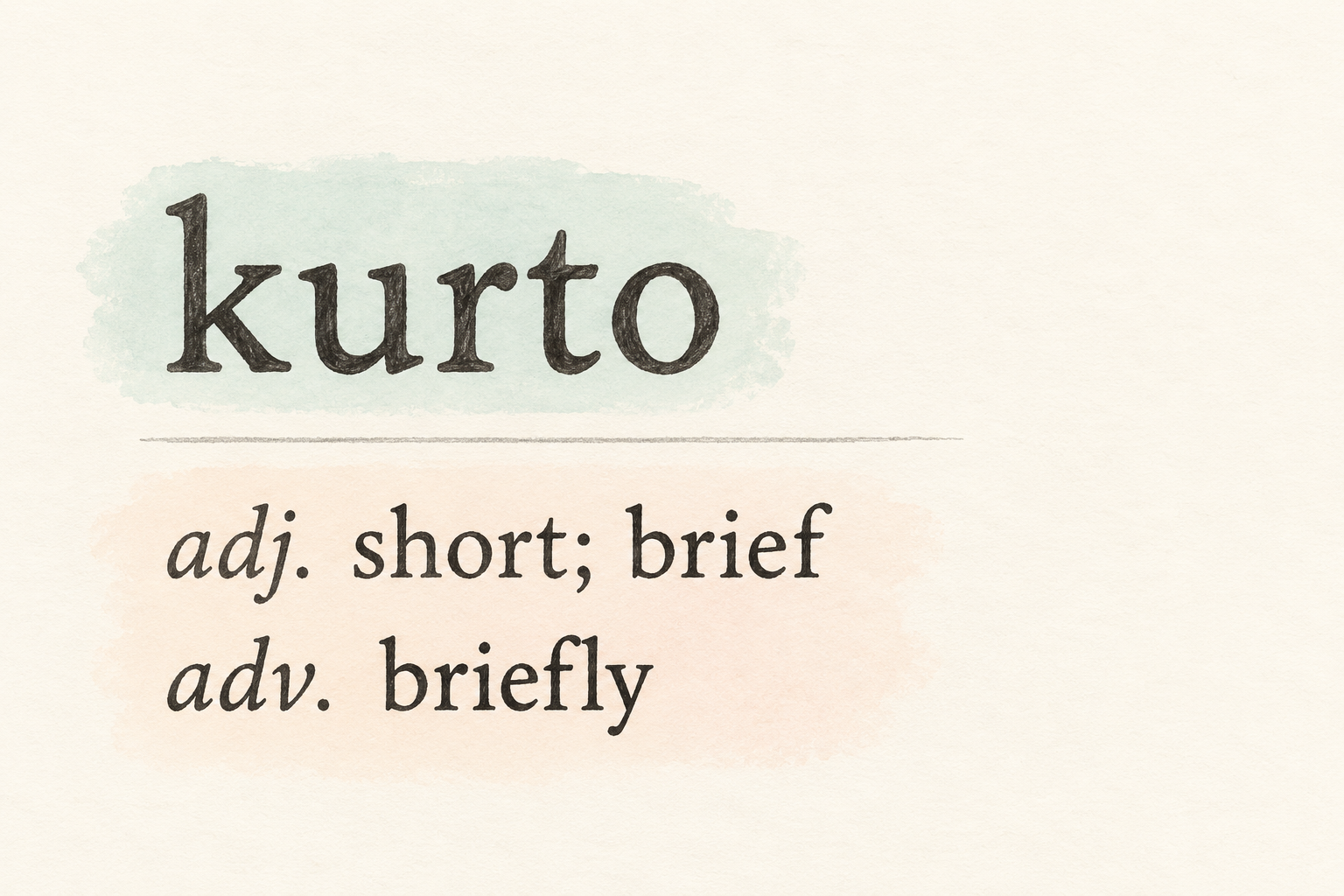
We will call the Ashort type that uses this alphabet Akurto, after the Globasa word kurto, meaning ‘short’.
Letters and values
The nonzero letters follow the same recurrence as before. We begin with 1, pair it with −1, and obtain each subsequent positive value by multiplying the previous positive value by three and subtracting one.
| Positive letter | Negative letter | Magnitude |
|---|---|---|
| a | e | 1 |
| b | p | 2 |
| c | j | 5 |
| d | t | 14 |
| f | v | 41 |
| g | k | 122 |
| h | x | 365 |
| i | u | 1,094 |
| l | r | 3,281 |
| m | n | 9,842 |
| s | z | 29,525 |
| w | y | 88,574 |
Notice that the values belong to letters in a particular alphabet: English-alphabet c represented two; Aglobasa c represents five. In Aglobasa, we have:
a = 1
e = −1
bc = 2 + 5 = 7
As before, concatenation means addition. To negate a numeral, replace each letter with its additive inverse:
pj = −bc = −7
Reading numerals aloud

The letters retain their Globasa sounds. Here is a pronunciation guide, following Globasa’s pronunciation guide.
The table gives each letter’s preferred sound in the International Phonetic Alphabet (IPA), arranged in Aglobasa order.
| Letter | IPA | Letter | IPA |
|---|---|---|---|
| o | [o̞] | ||
| a | [ä] | e | [e̞] |
| b | [b] | p | [pʰ] |
| c | [t͡ʃʰ] | j | [d͡ʒ] |
| d | [d] | t | [tʰ] |
| f | [f] | v | [v] |
| g | [ɡ] | k | [kʰ] |
| h | [x] | x | [ʃ] |
| i | [i] | u | [u] |
| l | [l] | r | [ɾ] |
| m | [m] | n | [n] |
| s | [s] | z | [z] |
| w | [w] | y | [j] |
The small ʰ marks a puff of breath after the consonant. Globasa also permits [h] for “h”.
The five vowels are simple sounds, as in Spanish or Italian: a as in ‘Thai’, e as in ‘let’, i as in ‘ski’, o as in ‘more’, and u as in ‘flu’.
The consonants b, d, f, k, l, m, n, p, t, v, w, z have their familiar English sounds. The remaining letters need a little more attention:
- c: ‘ch’ in ‘chair’.
- j: ‘j’ in ‘jazz’.
- g: always the hard ‘g’ in ‘good’.
- h: ‘ch’ in ‘Bach’; ‘h’ in ‘hotel’ is also allowed.
- r: ideally a single tap, as in Spanish.
- s: always ‘s’ in ‘sit’.
- x: ‘sh’ in ‘shop’.
- y: ‘y’ in ‘yes’.
Globasa has full letter names, such as aya for a and ibe for b. When spelling aloud, we may shorten them: vowels become a, e, i, o, u; consonants become be, ce, de, and so on. The added vowel has the e sound described above.
To read an Akurto numeral aloud, we can use these letter names in sequence. This works even when the written numeral contains no vowels.
For example, bc, representing seven, can be read:
be ce
Its negative, pj, can be read:
pe je
Pronounce every letter separately, including repeated vowels.
When a string is convenient to pronounce directly, we can also use its letter sounds.
This does not assign each integer a unique spoken name. Just as an integer can have several written representations, it can have several spoken representations:
bc = caa = 7
We can read the first as be ce and the second as ce a a. Their numerical values agree, although their written and spoken forms differ.
The same arithmetic
The letters and sounds have changed; concatenation and sign reversal still work as before.
For example, three can be written ba. Adding it to seven gives:
bc + ba = bcba = 10
For ten, c = 5 is the largest positive letter we can use. Taking it twice leaves no remainder, so the normal form is cc:
bcba = cc
This is the same normal-form procedure as before, using the values assigned to Akurto’s letters. For a negative number, find the normal form of its absolute value and flip each letter to its additive inverse.
We can also use o as we previously used ø: append it to mark the end of a numeral without changing its value.
bco bao
This lets us preserve boundaries when concatenating numerals:
bcobao
The expression evaluates to ten, while retaining separate representations of seven and three. Reading the terminating o as o makes those boundaries audible too.
Exercises
- Write four in two different ways in Akurto, and read both aloud.
- Find the value and normal form of dpe.
- Negate bcobao. What happens to the terminating letters?
We now have another way to write—and read aloud—the same arithmetic. In the next post, we will use it to represent Unicode code points and form strings.